
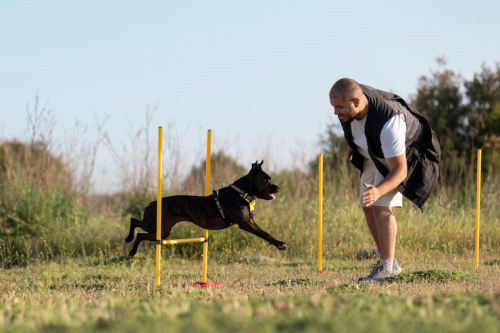
Understanding how dogs learn is one of the most important steps in building a healthy, respectful relationship between pets and their owners. Before advanced tricks, behavior shaping, or off-leash reliability, every dog benefits from a structured set of foundational abilities that guide how they respond to the world around them. These foundation skills in dog training are not about perfection or rigid control they are about communication, clarity, and consistency between human and dog.
For new dog owners, especially those navigating busy urban environments and diverse home routines, establishing these early skills can make daily life smoother and reduce common behavior challenges. Whether the goal is calmer walks, better recall, or simply a more confident companion, mastering basic dog training skills creates the framework everything else builds upon.
Your dog’s daily struggles pulling, mealtime anxiety, or reactivity don’t just cause stress, they chip away at the joy of being together. At Prime Paw, our positive reinforcement-based programs meet your dog where they are and build confidence, connection, and real skills. Our tailored programs in-person classes, coaching, and online resources help you enjoy calmer walks, relaxed routines, and a deeper connection. Ready for lasting change? Schedule a Prime Paw consultation today!
What Foundation Skills in Dog Training Really Mean
Foundation skills refer to the essential behaviors and communication cues that help a dog understand expectations in everyday situations. These are the early building blocks that shape obedience, impulse control, and responsiveness. They typically include simple but powerful actions like sitting on command, staying in place, responding to recall, and walking calmly on a leash.
These skills are not just about obedience for its own sake. They function as a shared language between dogs and their owners. When a dog understands what a cue means and what outcome follows, it reduces confusion and builds trust. Over time, this clarity supports better behavior in more complex environments such as crowded sidewalks, parks, or social settings.
According to professional training guidance on basic cues for puppies, foundational commands like sit, stay, and come provide structure that supports long-term learning and adaptability. These early lessons help puppies develop impulse control and confidence, both of which are essential for lifelong behavioral stability.
Core Basic Dog Training Skills Every Dog Should Learn First
The most effective training programs begin with a small set of essential cues that act as the backbone of communication. Among the most widely used are sit, down, stay, come, and loose-leash walking. These essential dog training commands are not arbitrary they directly influence how a dog behaves in real-world scenarios.
Mastering early obedience behaviors such as sit, stay, come, and loose-leash walking is widely recognized as the foundation of effective dog training. These skills help puppies understand expectations, build impulse control, and develop confidence across everyday situations ranging from mealtime routines to outdoor walks. Professional guidance emphasizes that positive reinforcement using rewards like treats, praise, or play makes learning more engaging and effective, encouraging dogs to repeat desired behaviors willingly. Short, consistent training sessions that end on a positive note help maintain motivation while strengthening the bond between dog and owner. Commands like recall improve safety in off-leash environments, while loose-leash walking transforms stressful pulling into calm, structured movement. Sit and down provide alternatives to jumping or overexcitement, and stay builds patience and focus needed for real-world distractions. Consistency across all household members is also critical, ensuring dogs receive clear and uniform signals that accelerate learning and reduce confusion. You can learn more about these principles in detail through basic cues for puppies.
For example, “sit” provides a calm alternative to jumping or overexcitement. “Stay” helps build patience and focus, especially during greetings or transitions. “Come,” often referred to as recall training for dogs, plays a critical safety role by ensuring a dog returns when called, even in distracting environments. Loose-leash walking, meanwhile, transforms stressful walks into structured, manageable outings.
These commands are most effective when introduced in short, consistent sessions that reward success rather than punish mistakes. Dogs learn best when training is predictable, engaging, and reinforced with positive outcomes such as treats, praise, or play. This approach, commonly known as positive reinforcement dog training methods, encourages dogs to repeat desired behaviors willingly.
Why Consistency Is the Foundation of Effective Training
One of the most overlooked aspects of training is consistency across all interactions. Dogs do not generalize rules automatically. If one person allows a behavior while another discourages it, the dog receives conflicting information, which slows learning and creates uncertainty.
Consistency across all family members plays a pivotal role in reinforcing foundation skills and ensuring dogs clearly understand expectations. When everyone in a household uses the same cues, rules, and reinforcement strategies, dogs learn more efficiently and with greater reliability. Mixed signals such as one person allowing jumping while another discourages it create confusion and slow progress, making it harder for dogs to generalize acceptable behavior. A unified approach to commands like sit, stay, recall, and leash manners helps establish clarity and trust, reducing anxiety and improving responsiveness. This consistency is especially important in multi-person households where dogs interact with different individuals throughout the day. Positive reinforcement is most effective when applied uniformly, strengthening desired behaviors through predictable rewards. Over time, this structured approach reduces issues like selective listening and behavioral inconsistency while supporting better socialization and impulse control. You can read more about this approach in the consistent family training guidance.
A consistent household approach where everyone uses the same cues, expectations, and rewards helps eliminate confusion. Research-based training guidance highlights that consistent family training plays a pivotal role in reinforcing foundation skills, making it easier for dogs to understand what is expected of them in different situations.
This consistency is especially important in environments where dogs interact with multiple people throughout the day. When rules around jumping, leash behavior, or table manners remain stable, dogs develop clearer behavioral patterns and respond more reliably to commands.
Positive Reinforcement and How Dogs Actually Learn
Modern training approaches emphasize motivation over correction. Dogs learn most effectively when they associate behaviors with positive outcomes. This is the core principle behind positive reinforcement.
Short, focused sessions are particularly effective for introducing puppy training basics. Dogs, especially younger ones, have limited attention spans, so breaking training into manageable moments helps maintain engagement. Ending each session on a positive note also reinforces confidence and willingness to continue learning.
Training guidance on foundational puppy commands emphasizes that reinforcement should be immediate and consistent. When a dog performs a desired behavior and receives a reward right away, the connection between action and outcome becomes stronger. This accelerates learning and reduces frustration.
Positive reinforcement is not only about treats. Praise, play, and affection can be equally effective motivators depending on the individual dog. The key is understanding what each dog finds rewarding and using that consistently to shape behavior over time.
Leash Training Basics and Recall as Core Foundation Skills
Among all foundational behaviors, leash walking and recall are often the most practical in everyday life. Leash training basics focus on teaching a dog to walk calmly without pulling, which improves safety and reduces stress during outings. This is particularly important in urban environments where distractions are frequent and space is limited.
Recall training for dogs, on the other hand, is one of the most important safety-related skills. A reliable recall ensures that a dog returns when called, even in the presence of distractions. This behavior is built gradually, starting in low-distraction environments before progressing to more challenging settings.
Both leash walking and recall rely heavily on repetition and reinforcement. They are not one-time lessons but ongoing skills that require reinforcement throughout a dog’s life. When practiced consistently, they become automatic responses rather than learned commands that require constant correction.
Building Structure and Routine for Long-term Success
Dogs thrive in environments where expectations are clear and routines are predictable. Structure helps reduce anxiety and supports better decision-making. This is particularly important during the early stages of learning, when dogs are still forming associations between behavior and outcome.
In households with multiple family members, aligning on daily routines and training cues is essential. Feeding schedules, walking times, and play sessions all contribute to a dog’s sense of stability. When combined with consistent reinforcement, these routines strengthen foundational learning.
Many new dog owners in busy neighborhoods such as Mission District, SoMa, and Noe Valley find that integrating short training moments into daily routines such as practicing “sit” before walks or “stay” before meals helps reinforce behavior without requiring dedicated training blocks.
This integration of learning into everyday life is what transforms basic commands into reliable habits. Over time, dogs begin to anticipate expectations and respond appropriately even without explicit prompts, which reflects true understanding rather than memorization.
How Beginners Can Start Building Foundation Skills
For those just beginning their training journey, the most effective approach is simplicity and consistency. Start with one or two commands at a time rather than attempting to teach everything at once. Focus on clarity in communication and ensure that each successful response is rewarded.
Training sessions should be short, positive, and repeated regularly. It is better to practice for a few minutes multiple times a day than to conduct long, infrequent sessions. This helps reinforce learning and keeps the experience enjoyable for the dog.
It is also important to avoid mixing cues or changing expectations mid-training. Dogs rely on repetition and pattern recognition, so consistency is critical for progress. When all household members follow the same approach, learning becomes significantly faster and more stable.
As foundation skills develop, owners often notice improvements in behavior beyond formal training sessions. Dogs become more attentive, calmer in new environments, and more responsive to guidance. These changes reflect the broader impact of strong dog obedience fundamentals built on clear communication and positive reinforcement.
Building Better Communication Through Foundation Skills
Foundation skills are not just training steps they are the core language through which dogs and humans understand each other. By focusing on clarity, consistency, and positive reinforcement, owners can create a structured learning environment that supports long-term behavioral success.
Whether teaching a puppy their first commands or refining behavior in an adult dog, these skills provide the framework for everything that follows. With patience and repetition, how to train a dog to sit and stay becomes less about instruction and more about communication, trust, and shared understanding between dog and owner.
As dogs grow and adapt, these foundational lessons remain the anchor for all future learning, shaping not only behavior but also the relationship itself.
Frequently Asked Questions
What are foundation skills in dog training?
Foundation skills in dog training are the essential behaviors and communication cues that help dogs understand expectations in everyday life. These include basic commands like sit, stay, come (recall), and loose-leash walking. They create a shared language between dogs and owners, building trust, clarity, and long-term behavioral stability.
What basic dog training commands should every dog learn first?
The most important basic dog training commands include sit, down, stay, come, and loose-leash walking. These foundational dog training skills help improve impulse control, safety, and everyday behavior. When taught with positive reinforcement, they become reliable habits that support more advanced training later on.
Why is consistency important in dog training and positive reinforcement?
Consistency in dog training ensures that all household members use the same cues, rules, and expectations, which reduces confusion for the dog. Without consistency, dogs may receive mixed signals that slow learning and lead to behavioral issues. Combined with positive reinforcement dog training methods, consistency helps reinforce desired behaviors and strengthens long-term obedience.
Disclaimer: The above helpful resources content contains personal opinions and experiences. The information provided is for general knowledge and does not constitute professional advice.
You may also be interested in: Customized Training Addresses Unique Needs of Each Puppy
Your dog’s daily struggles pulling, mealtime anxiety, or reactivity don’t just cause stress, they chip away at the joy of being together. At Prime Paw, our positive reinforcement-based programs meet your dog where they are and build confidence, connection, and real skills. Our tailored programs in-person classes, coaching, and online resources help you enjoy calmer walks, relaxed routines, and a deeper connection. Ready for lasting change? Schedule a Prime Paw consultation today!
Powered by flareAI.co